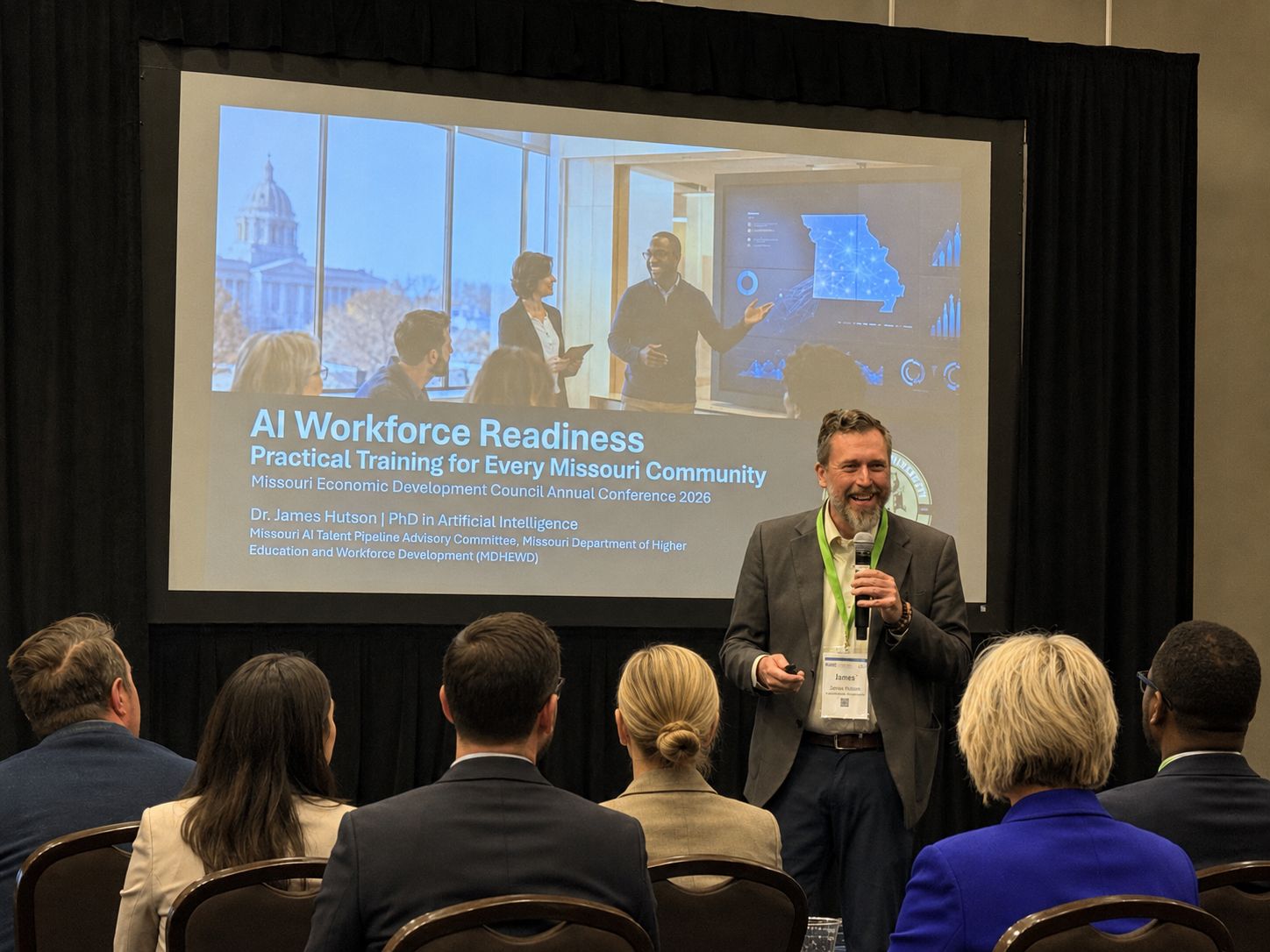
Contributed by Dr. James Hutson, Director of AI-Enabled Academic Transformation, College of Arts and Humanities, Lindenwood University
AI Is No Longer Optional in the Workplace
Artificial intelligence has moved from novelty to workplace infrastructure. Across industries, professionals are no longer asking whether AI will affect their work; they are asking how quickly they can learn to use it responsibly, creatively, and strategically.
For several years, much of the public conversation focused on whether AI would “replace” people. That question is too narrow for the transformation already underway. The better question is: who will be prepared to redesign work when AI becomes part of nearly every workflow?
The answer will not come only from computer scientists, engineers, or data specialists. It will also come from professionals across fields who understand how AI can extend human capability without displacing human judgment, including:
- Educators
- Managers
- Designers
- Analysts
- Communicators
- Healthcare professionals
- Public servants
- Entrepreneurs
- Creative workers
That is the central premise of human-centered artificial intelligence: AI should augment human capacity, improve decision-making, and support more responsible systems, but it should not obscure accountability, ethics, or the lived realities of the people affected by technological change.
The Workplace Needs More Than AI Tool Users
Recent workforce research points to a clear conclusion: organizational AI adoption is accelerating, but AI literacy, governance, and applied workforce readiness are not keeping pace. Professionals are increasingly expected to know more than how to prompt a chatbot.
They need to understand:
- When AI should and should not be used
- How AI-generated outputs should be evaluated
- How risks such as bias, inaccuracy, privacy exposure, and over-reliance should be mitigated
- How human judgment should remain central to consequential decisions
- How AI can be integrated into workflows without weakening accountability
This shift is already changing the architecture of work. Many organizations are moving beyond individual experimentation with AI tools and toward more complex forms of human-AI collaboration across teams, departments, and entire workflows.
As AI takes on more tactical execution, humans do not become irrelevant. Their roles become more concentrated around direction-setting, quality assurance, contextual reasoning, interpersonal understanding, creativity, and ethical accountability. In practical terms, the future of work is not less human. It is more dependent on distinctively human forms of expertise.
Why Human-Centered AI Matters
A poorly designed workflow does not become intelligent simply because an AI tool has been added to it. It becomes a faster version of the same problem.
Human-centered AI asks better questions:
- Who will use this system?
- Who will be affected by it?
- Can its outputs be verified?
- Does it improve the quality of work, or does it merely accelerate flawed processes?
- Does it reduce bias, improve access, and support meaningful oversight?
- Does it create new forms of risk that leaders, employees, or communities may not yet understand?
These questions matter because AI adoption is not only a technical challenge. It is also a human, organizational, ethical, and cultural challenge. The professionals who will lead in this environment will be those who can bridge technical fluency with human judgment.
How Lindenwood’s MA in Human-Centered AI Helps Professionals Get Ahead
Lindenwood University’s Master of Arts in Human-Centered Artificial Intelligence was designed for this moment. The program prepares professionals and career changers to engage AI through an applied, interdisciplinary, and ethically grounded lens.
The degree is especially relevant for working adults because it is designed to be accessible, flexible, and practical. Students do not need previous experience in artificial intelligence, machine learning, mathematics, or computer science. Instead, the program is built for professionals who recognize that AI will affect their industries and want to move from uncertainty to agency.
Key features of the program include:
- 30 credit hours
- 100% asynchronous online format
- Designed for completion in one to two years
- No prior AI, machine learning, mathematics, or computer science experience required
- Applied coursework connected to real workplace challenges
- Thesis or applied project options
- Interdisciplinary emphasis through the College of Arts and Humanities
The program brings together technology, ethics, human behavior, design, communication, data analysis, and applied problem-solving. That combination is essential because the workplace does not simply need more AI users. It needs professionals who can evaluate AI outputs, communicate implications, design better processes, lead responsible adoption, and translate between technical and nontechnical teams.
What Students Learn
Students in the MA in Human-Centered AI study AI principles and applications while also examining the human contexts in which intelligent systems are developed, deployed, interpreted, and governed.
Coursework includes areas such as:
- Data Analysis and Visualization: Students learn to interpret information and communicate insights clearly.
- AI for Skill Development: Students explore how AI can support learning, training, and workforce growth.
- Coding and Scripting with Generative AI: Students gain practical experience working with AI-assisted technical tools.
- Advanced Research and Writing with AI: Students learn to use AI critically and responsibly in knowledge work.
- Human-AI Collaboration: Students examine how people and intelligent systems can work together effectively, ethically, and productively.
This curriculum prepares students to think beyond tool use. It helps them understand AI as part of a larger ecosystem involving people, policies, workflows, institutions, and social consequences.
Why This Degree Applies Across Industries
Human-centered AI is relevant because AI is no longer confined to one sector. It is reshaping communication, business operations, education, healthcare, public service, creative production, research, and organizational strategy.
For example:
- A marketing professional may use AI to analyze audiences and generate campaign concepts, but human-centered training helps evaluate bias, brand risk, privacy implications, and audience trust.
- A healthcare administrator may explore AI-supported scheduling, documentation, or communication, but must also consider safety, consent, accessibility, and regulatory expectations.
- An educator may use AI for feedback or adaptive learning, but should be prepared to address academic integrity, equity, cognitive development, and over-reliance.
- A business leader may see AI as a productivity tool, but human-centered AI reframes it as an organizational design challenge involving culture, training, incentives, governance, and measurable value.
- A public-sector professional may see AI as a way to improve service delivery, but must also consider transparency, accountability, fairness, and public trust.
- A creative professional may use AI to expand ideation and production, but still needs the conceptual judgment to shape meaning, audience experience, and originality.
In each case, AI creates value only when professionals understand both its capabilities and its limits.
The Real Career Advantage
Getting ahead of the AI curve does not mean chasing every new tool. It means developing the intellectual discipline to ask better questions, the applied skills to test better solutions, and the ethical confidence to know when restraint is as important as innovation.
The most valuable professionals in the AI-shaped workplace will be those who can combine:
- Analytical thinking with empathy
- Automation with accountability
- Technical experimentation with social consequence
- Productivity with ethics
- Innovation with human judgment
Lindenwood’s MA in Human-Centered AI gives professionals a way to enter the AI conversation without abandoning their existing expertise. More importantly, it helps them transform that expertise into leadership.
AI will continue to change the workplace, and no degree can freeze a moving technology into a fixed body of knowledge. What this program offers instead is a durable framework for adaptation: human-centered judgment, responsible design, applied fluency, and the capacity to lead as work itself is redesigned.
For professionals ready to move beyond uncertainty and into agency, that is the advantage that matters.