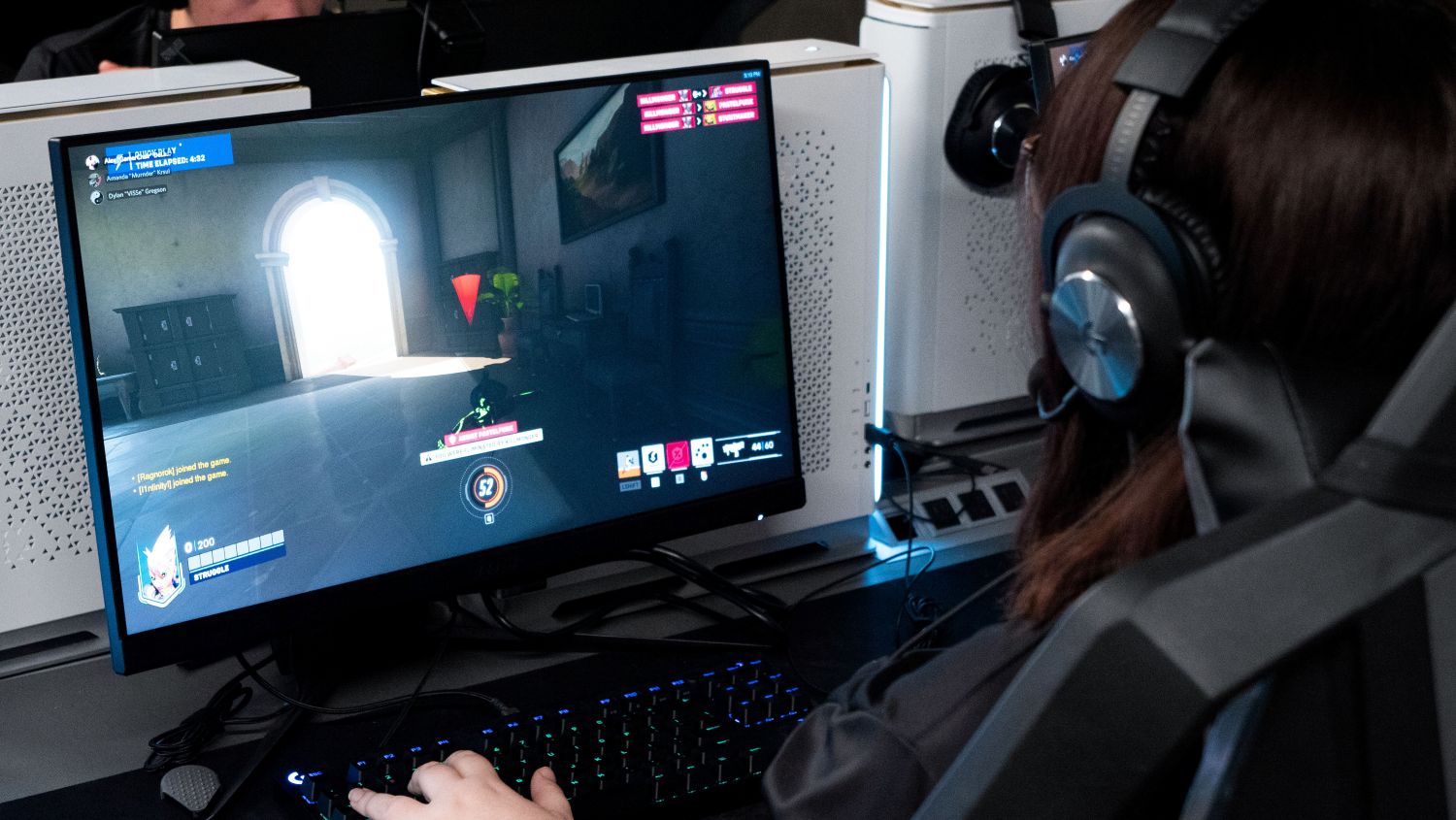
More than 212 million Americans play video games for at least one hour each week, and U.S. consumer spending reached $60.7 billion in 2025, according to the Entertainment Software Association.
Search the question and you will find forum threads arguing that a degree is worthless because studios hire on portfolio. Studios do hire on portfolio. A structured program exists to produce that portfolio, on a deadline, with a team, under critique, and whether a specific program does that is what an applicant should be evaluating.
What a game design degree actually covers
Game design is interdisciplinary, drawing on visual storytelling, programming, interactive media, and systems thinking. A strong program helps students build foundational fluency across these areas while developing deeper expertise aligned with their goals.
At Lindenwood, the Game Design BA runs 120 total credit hours with 36 credit hours in the major, divided between required coursework and electives. The required sequence moves in a deliberate order:
- GAM 10000 Introduction to Game Design establishes vocabulary and mechanics
- AAD 20300 Adobe Certification in Photoshop and AAD 33600 3D Graphics build the asset pipeline
- GAM 23000 Prototype Studio forces a playable build
- GAM 30100 Team Studio and GAM 42400 Game Design Firm put that build in front of collaborators
- GAM 36800 Game Development ties production practice to the rest
Electives let a student specialize. Scripting for Games and Level Design push toward technical roles. Audio for Games and 3D Animation push toward production art. Game Testing points at QA, which remains a standard entry door into a studio. History of Games and Critical Theory covers the design literacy that separates a person who copies mechanics from one who understands why they work.
The studio sequence matters more than the course list
Prototype Studio, Team Studio, and Game Design Firm function as the spine of the degree. They are the closest classroom analogue to studio production, because they impose the two conditions a solo project never does: other people’s code in your build, and a date you do not control.
Employers read portfolios for evidence of exactly that. A polished solo project shows craft. A shipped team project shows a candidate can integrate, take notes, cut scope, and finish. Lindenwood students have worked on projects with Sinespace, the Boys and Girls Club, and the St. Louis Game Dev Co-Op, which puts external stakeholders into the same equation.
What belongs in the portfolio
Hiring managers in games look for four things, and a degree program should produce all of them before graduation.
One finished, playable project. Finished beats ambitious. A small game that starts, plays, and ends demonstrates scope control, which is the skill studios complain most about in junior hires.
Evidence of iteration. Show the version that failed playtesting and the change that fixed it. Design roles are judged on the ability to respond to data about a build, not on the first idea.
A clear statement of what you personally built. Team projects raise the immediate question of individual contribution. Candidates who answer it precisely, naming systems, levels, or assets they owned, get further than those who describe the project generically.
Range within a specialization. Depth in one discipline with enough breadth to communicate across the others. A level designer who can talk to programmers about performance budgets is more useful than one who cannot.
What game designers earn
The federal government does not track “game designer” as an occupation, which is why salary figures for the role vary so wildly across the web. Any number presented as an official game designer median is being sourced from somewhere other than federal wage data.
Two Bureau of Labor Statistics occupations do capture where game design graduates land:
| Occupation | Median annual wage (May 2024) | Projected growth, 2024 to 2034 |
| Special effects artists and animators | $99,800 | 2% |
| Software developers | $133,080 | 16% |
Read those two rows together and the career math becomes clear. The art side pays well and grows slowly, with roughly 900 net new positions projected across the decade. The technical side pays better and grows fast, at 16 percent against an economy-wide average well below that.
Scripting, engine work, tools programming, and technical art carry the stronger labor-market position, and a student choosing electives should weight the decision accordingly. A student who wants the art path should take it with clear eyes and build technical skills alongside it, because designers who can both model an asset and script its behavior compete in both markets.
Whether the degree is necessary
Studios hire on portfolio. Nobody disputes this. The useful question is what produces a portfolio strong enough to compete, and the honest answer is that most people do not build one alone.
A degree supplies four things that are difficult to assemble independently:
Deadlines with consequences. Self-directed projects stall. Graded milestones do not.
Critique from people who are not your friends. Faculty and cohort reviews surface problems before a hiring manager does.
Collaborators. Games are made by teams. A solo portfolio cannot demonstrate team skills, and a graduate leaves with people who have shipped alongside them.
Equipment and software access. Lindenwood maintains a dedicated game lab with industry software, immersive reality technology and virtual reality headsets, and an esports arena.
The counterargument holds for a specific kind of person: someone already shipping, already networked, already disciplined. That person should skip the degree. Most eighteen-year-olds are not that person, and the degree is a structure for becoming one.
Choosing between a bachelor’s, a minor, and a master’s
Lindenwood offers three levels of commitment, which is useful because game design attracts students whose primary interest sits elsewhere.
Game Design BA, 120 credit hours. The full path, offered in St. Charles, St. Louis, and online. Campus students complete some coursework online. The online version accepts up to 90 transfer credits. A Game Art Emphasis adds drawing, concept design, and 3D animation for students targeting visual roles.
Game Design Minor, 18 credit hours. Six courses covering digital foundations, concept design, 3D graphics, games history, introduction to game design, and level design. This is the right choice for a computer science, art, or writing major who wants credentialed game work without restructuring a degree.
Game Design MA, 30 credit hours. Fifteen to eighteen months, on campus, online, or blended, with the GRE requirement waived. Two completion paths: an applied project built for an outside organization, or a thesis developing original research across the final two semesters. The applied option suits career changers who need a portfolio piece with a real client attached.
Admission to the online BA requires applicants to submit an application and transcripts from all colleges attended. Those with fewer than 24 college credits also submit a high school transcript. Applicants with a cumulative college GPA below 2.0 submit a résumé and a one- to two-page personal statement or letter of intent.
Graduate applicants are first reviewed by Lindenwood University’s Office of Admissions to confirm general admission requirements are met. Applicants to the College of Arts and Humanities also submit transcripts showing a related undergraduate degree with a minimum 3.0 GPA in major coursework, three academic or professional references, a 1,000-word statement of purpose, and any program-specific materials such as a writing sample or portfolio. GRE scores may be required for applicants with a GPA below 3.0.
The roles a game design graduate can target
“Game designer” is a job title inside studios, not an umbrella for everyone who works on games. Lindenwood lists graduate outcomes including mechanics designer, writer, concept artist, modeler, art director, engine specialist, programmer, and games tester. Those roles want different things from a transcript.
Systems and mechanics designer. Builds the rules: economies, progression, combat math, difficulty curves. Wants evidence of design documentation and balance iteration. Introduction to Game Design and the studio sequence feed this directly, and History of Games and Critical Theory supplies the reference library.
Level designer. Shapes space, pacing, and player guidance. Level Design is the named course, and the portfolio expectation is specific: playable spaces with a stated intent and a record of how playtesting changed them.
Technical artist. Sits between art and engineering, building shaders, rigs, and tools so artists can work faster. Studios hire for it persistently, and it is the strongest argument for pairing 3D Graphics and 3D Animation with Scripting for Games.
Gameplay or engine programmer. Writes the code. Maps to the software developer wage data above, and a game design degree alone is usually not sufficient here. Students targeting it should pair the major with computer science coursework.
QA analyst and test lead. The most common entry point into a studio, and a legitimate one. Game Testing covers the methodology. QA staff who document well and understand systems move into design and production more often than the role’s reputation suggests.
Producer. Runs schedule, scope, and communication. Rarely hired at entry level, frequently grown from QA or design. Team Studio and II are where a student discovers whether they are wired for it.
A student who reads that list and cannot yet say which row they want has picked the right major, because the studio sequence is designed to answer exactly that question before graduation.
Online versus on campus
Lindenwood offers the BA in both formats, and the choice carries real tradeoffs rather than a right answer.
On campus in St. Charles or St. Louis provides the game lab, the immersive reality hardware, the esports arena, and unscheduled contact with the cohort. Team projects are meaningfully easier when collaborators share a room, and the informal critique that happens between classes is a large part of what a studio program is selling. Campus students still complete some coursework online.
The 100 percent online BA removes geography from the equation and accepts up to 90 transfer credits (subject to evaluation and degree requirements), which matters for students finishing a degree started elsewhere or working while enrolled. The tradeoff is that team coordination becomes an explicit skill rather than a byproduct of proximity, and hardware access shifts to the student.
Online study offers flexibility and can build remote collaboration skills, but it also requires consistent time management and active participation in teamwork.
Questions applicants ask before committing
Is game design a hard major? It is a workload major more than a difficulty major. The studio courses compress art production, programming, and project management into the same semester, and the deadlines are real. Students who struggle usually struggle with scope control, not with any single skill.
How much math is involved? Enough to matter on the technical track. Level design and scripting lean on coordinate geometry, vectors, and basic linear algebra. The art track requires far less. Neither approaches the math load of a computer science degree.
How will AI impact game designers? AI tools are influencing ideation, prototyping, and asset workflows while raising questions about authorship, copyright, source data, and craft. Lindenwood students benefit from design judgment, visual storytelling, collaboration, technical literacy, and responsible use of emerging AI tools.
Does the school’s name matter? Less than the portfolio, more than nothing. What helps more is a graduate walking into an interview with a shipped team project and a clear account of what they built.
One more consideration applies regardless of path. The industry hires in cycles, and those cycles are volatile. Students entering during a contraction should weight technical skills more heavily, because engine, tools, and technical art roles remain in demand when studios slow production. Students entering during expansion have more freedom to specialize in art. Neither condition changes the value of a finished, shipped project.
Where to start
Applicants generally fall into three groups. A student certain about games should look hard at the BA and the studio sequence inside it. A student with a different major and a real interest should take the 18-hour minor. A working professional changing direction should look at the MA applied project, since it produces a client-attached portfolio piece in fifteen to eighteen months.
Whichever fits, the next step is the same. Review the Game Design BA curriculum, compare the required sequence against the roles you want, and apply through Lindenwood’s admissions portal. Lindenwood has been continuously accredited by the Higher Learning Commission since 1921.